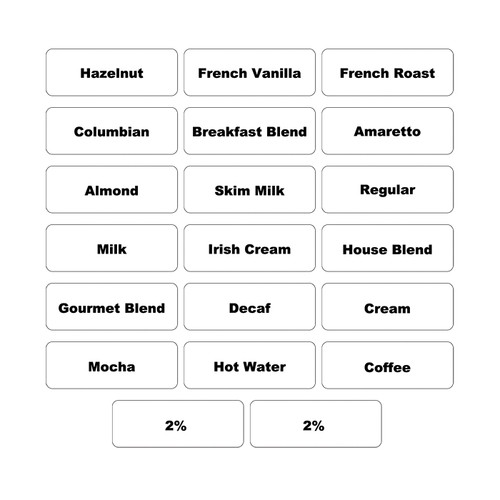

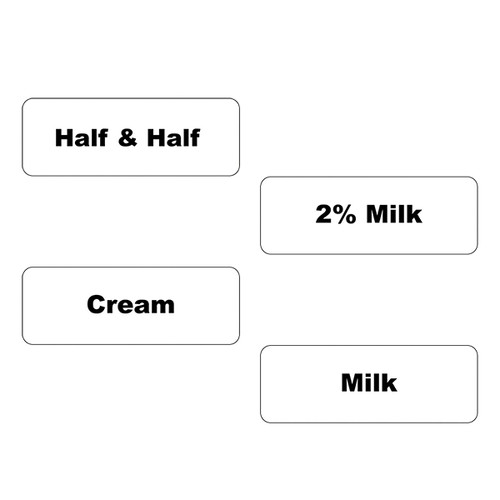
These static cling labels provide consistent identification for cream, milk, 2%, and half & half in busy service lines, helping to reduce errors and maintain organization. The sheets are designed to meet foodservice pace and sanitation standards while being easy to apply and replace.
LongDescription#@#NA#@@#Cleaning Instructions#@#Wipe labels and surrounding dispenser surfaces with a microfiber cloth and a neutral detergent solution, rinsing with clean water and drying immediately. Use a 1:100 bleach solution or EPA-registered sanitizer on high-touch zones like dispenser handles, menu covers, chair backs, and door handles, contact time per label. Clean spills and crumbs daily to deter pests and prevent contamination of food and hands. Inspect labels for residue; replace sheets if adhesive fails.#@@#Additional Info#@#Service Ideas SC1CBCL static cling labels measure 3.5" wide by 1.25" deep. Each sheet has 20 labels with black lettering for beverage identification, including cream, milk, 2%, and half & half.#@@#General Info#@#Description #@#
These static cling labels provide consistent identification for cream, milk, 2%, and half & half in busy service lines, helping to reduce errors and maintain organization. The sheets are designed to meet foodservice pace and sanitation standards while being easy to apply and replace.
Sheets feature black lettering on a clear background sized at 3.5 inches wide and 1.25 inches deep for immediate readability. Staff can easily read labels across counters and carts, decreasing mispours and improving portion accuracy.
Each sheet includes five labels for cream, five for milk, five for 2%, and five for half & half, totaling twenty labels per sheet. This allows managers to standardize signage across multiple dispensers or shifts without custom printing.
Manufacturers produced the clings for repeated handling and cleaning cycles common in cafeterias and catering lines. Teams can reposition clings without adhesive residue, maintaining clean surfaces and consistent presentation.
Production occurs domestically to support supply chain reliability and local quality controls. Procurement leads will appreciate reduced lead times and traceable manufacturing.
Users apply clings directly to smooth dispenser surfaces without tools or adhesives, enabling quick setup during service changes. Staff can replace worn labels in seconds, minimizing downtime.
Sheets pack flat and occupy minimal storage space, allowing kitchens and carts to carry spares without clutter. Inventory managers can store multiple sheets in a single drawer or service box.
Product weight registers at 0.2 pounds per sheet, and the format suits uninsulated dispenser parts and cling-on applications in foodservice environments. Operators working under institution guidelines will find the signage compatible with standard sanitation procedures.
#@@#Delivery Details#@#
• Please ensure to handle the product with utmost care.
• Check if the product you have received has all the essential parts and accessories.
• Make sure to examine the product for damage before signing the delivery receipt.
• Contact customer service for delivery concerns.
• Delivery times may vary based on location.#@@#deliverynotes#@#NA#@@#Maintenance Guide#@#Clean labels before application using isopropyl alcohol on a lint-free cloth to ensure adhesion and prevent contamination. Rotate sheets weekly in high-use lines and store spares flat at room temperature away from direct sunlight. Inspect edges and replace sheets that curl or delaminate to avoid misidentification. Use gloves when handling product to limit oils on surfaces. Record replacement dates and maintain a log to support inventory control and regulatory traceability.