

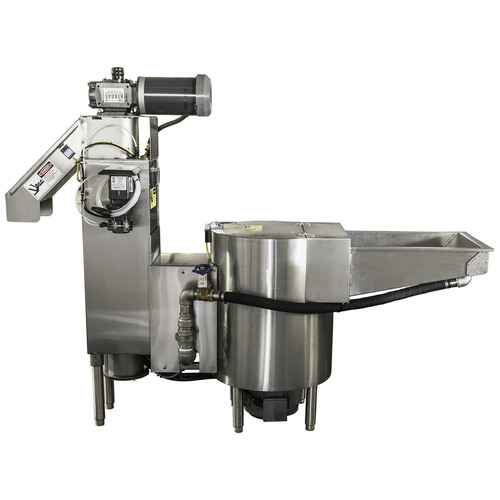
Stop outsourcing waste problems to costly hauling and time-consuming labor. This industrial pulping system converts up to 900 pounds of food waste per hour into a semi-dry pulp, dramatically shrinking on-site volume and lowering disposal expenses while returning process water for reuse to reduce fresh water demand.
LongDescription#@#NA#@@#Cleaning Instructions#@#Unplug the unit and lock out power at 208v before servicing. Remove solids from the feed tray and flush the pulping tank with potable water. Mix mild detergent with warm water and scrub the grind chamber and tray; avoid abrasive pads. Rinse thoroughly and run the Hydra-Extractor to purge slurry. Inspect seals and replace worn gaskets. Clean condenser coils and vents to prevent grease buildup. Cycle dry before reconnecting power to resume operation.#@@#Additional Info#@#Somat SPC50 Pulper Close Coupled 5hp processes 900 pounds of waste per hour, reduces volume 8:1, and achieves 85% reduction. The 5 HP, 208v, 3-Ph system grinds waste into slurry, dewaters via Hydra-Extractor®, and discharges semi-dry pulp.#@@#General Info#@#Description #@#
Stop outsourcing waste problems to costly hauling and time-consuming labor. This industrial pulping system converts up to 900 pounds of food waste per hour into a semi-dry pulp, dramatically shrinking on-site volume and lowering disposal expenses while returning process water for reuse to reduce fresh water demand.
#@@# High-Capacity Processing#@#
This unit handles up to 900 pounds per hour, enabling continuous throughput during peak service periods. Operators can process large daily waste loads without repeated cycle interruptions, which reduces labor and hauling frequency.
#@@# Volume Reduction Efficiency#@#
Engineered to achieve an 8 to 1 reduction, the pulper removes as much as 85% of original waste volume through mechanical grinding and de-watering. Kitchen managers benefit from fewer container swaps and lower transport costs because haul-away volume decreases significantly.
#@@# Integrated De-Watering System#@#
The system feeds slurry into a Hydra-Extractor that separates liquid from solids and discharges semi-dry pulp. Facilities avoid excess liquid hauling and achieve more compact waste output suitable for direct container removal or further dehydration.
#@@# Water Recovery Loop#@#
Recovered process water returns to the pulping tank for reuse by the feed tray or scrapping trough, reducing fresh water consumption. Sustainability officers receive measurable reductions in water usage and fewer recycling demands.
#@@# Robust Power Configuration#@#
Designed for 208 volts, 3-Phase service with a 5 HP motor, the unit delivers reliable mechanical force for grinding and extraction. Maintenance teams encounter predictable electrical requirements that match standard commercial electrical infrastructure.
#@@# Operational Versatility#@#
Compostable waste enters via a feed tray or scrapping trough to accommodate different kitchen workflows. Staff retain flexibility in loading methods, which minimizes disruption to food preparation lines and accelerates waste handling.
#@@#Delivery Details#@#
• Please ensure to handle the product with utmost care.
• Check if the product you have received has all the essential parts and accessories.
• Make sure to examine the product for damage before signing the delivery receipt.
• Contact customer service for delivery concerns.
• Delivery times may vary based on location.#@@#deliverynotes#@#NA#@@#Maintenance Guide#@#Inspect pulper bearings and seals monthly, and tighten mounting bolts to maintain alignment. Flush the pulping tank weekly with potable water to prevent buildup; operate the Hydra-Extractor® during flushing to remove solids. Clean feed tray and scrapping trough after each shift and sanitize with approved detergent. Verify voltage and phase at installation and confirm 208v, 3-Ph supply matches nameplate. Replace worn blades and check pump couplings every 3 months.