

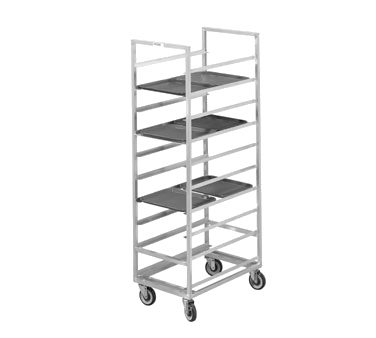
Stop sacrificing durability for mobility. This tray rack confidently moves full loads while protecting trays and speeding up cafeteria service, enabling staff to stack, transport, and store with fewer trips and interruptions. Designed for institutional food service, the unit balances capacity, maneuverability, and corrosion resistance to meet daily operational demands.
LongDescription#@#NA#@@#Cleaning Instructions#@#Wipe aluminum rack and trays with mild detergent and warm water, scrub 3" angle channels and caster mounts with a soft brush, rinse and air dry. Disinfect high-touch zones—tray edges, caster plates, chair-contact points—using EPA-registered sanitizer at label dilution; follow contact time. Inspect for food buildup under shelves and in crevices; remove debris to deter pests and prevent contamination of clean trays and hands. Maintain records for CSA and health inspections.#@@#Additional Info#@#Channel 437A3 Cafeteria Tray Rack features a single-section aluminum frame (21" W x 30" D x 36" H) that holds 18 trays (9 pair) with 3" spacing. NSF-certified, made in USA, with 5" swivel casters, weighs 24 lbs, ideal for food service transport.#@@#General Info#@#Description #@#
Stop sacrificing durability for mobility. This tray rack confidently moves full loads while protecting trays and speeding up cafeteria service, enabling staff to stack, transport, and store with fewer trips and interruptions. Designed for institutional food service, the unit balances capacity, maneuverability, and corrosion resistance to meet daily operational demands.
#@@# Tray Capacity#@#
Holds eighteen trays arranged as nine pairs, providing organized transport and storage for peak meal periods. Operators reduce handling time and maintain portion flow by loading two trays per level across three-inch angle spacing.
#@@# Aluminum Construction#@#
Constructed from aluminum for a favorable strength-to-weight ratio and corrosion resistance in humid kitchen environments. Staff members benefit from a lighter unit that resists rust and simplifies sanitation compared to ferrous alternatives.
#@@# End Load Design#@#
Positions trays for end access, allowing line workers to slide trays on and off quickly during serving windows. Supervisors observe improved throughput because staff avoid side maneuvering and maintain a steady forward workflow.
#@@# Casters and Mobility#@#
Equipped with 5-inch swivel plate casters that provide responsive turning and smooth rolling on cafeteria floors. Teams navigate crowded corridors with reduced effort, and the caster design minimizes floor marking and wheel lock incidents.
#@@# Compact Footprint#@#
Measures 21 inches wide by 30 inches deep and stands 36 inches high, fitting standard service aisles and storage closets. Facilities preserve aisle clearance and optimize space planning while retaining substantial tray capacity.
#@@# Compliance and Origin#@#
Meets NSF requirements and ships from a U.S. manufacturer with a documented production pedigree since 1998. Buyers gain assurance from domestic construction and third-party sanitation certification.
#@@#Delivery Details#@#
• Please ensure to handle the product with utmost care.
• Check if the product you have received has all the essential parts and accessories.
• Make sure to examine the product for damage before signing the delivery receipt.
• Contact customer service for delivery concerns.
• Delivery times may vary based on location.#@@#deliverynotes#@#NA#@@#Maintenance Guide#@#Maintain the Channel 437A3 Cafeteria Tray Rack by inspecting casters weekly and tightening mounting hardware to preserve mobility. Clean aluminum surfaces with a neutral pH detergent and rinse to prevent residue buildup. Verify end-load slides engage smoothly; lubricate 3" angle spacings with food-grade lubricant when friction increases. Replace worn seals or bent trays promptly. Balance loads across levels to prevent frame stress and ensure NSF compliance during inspections.